
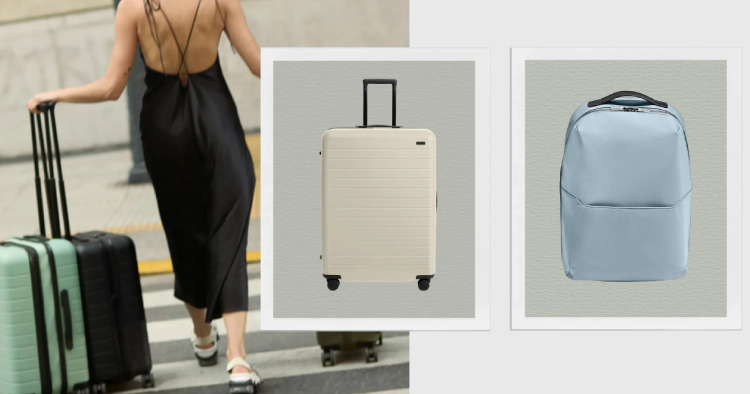
The last time I checked a bag I waited forty minutes at baggage claim, watched everyone else from my flight collect their things and leave, and then spent the next ten minutes convincing myself the airline hadn’t lost it. They hadn’t. It came out eventually, slightly dented, and I pushed it through the airport thinking — I am never doing this again if I can help it.
That was about three years ago and I’ve been carry-on only ever since for any trip up to ten days. It takes some thought the first few times — what to pack, how to pack it, what’s actually necessary versus what you’re just bringing because it fits in a bigger bag. But once you figure it out the travel experience changes completely. You walk off the plane and straight to wherever you’re going. No waiting, no checking in at the other end, no hoping the bag makes it when you have a tight connection.
The bag you carry matters a lot for this. A bag designed for carry-on travel solves different problems from a regular weekend bag or an oversized tote. It needs to fit airline requirements, hold more than it looks like it should, and keep things organised in a way that means you’re not repacking every time you need to find something.
I’ve been using Luhxe for the past year and a half and it’s what made the carry-on-only approach actually work for me.
Available at luhxe.com
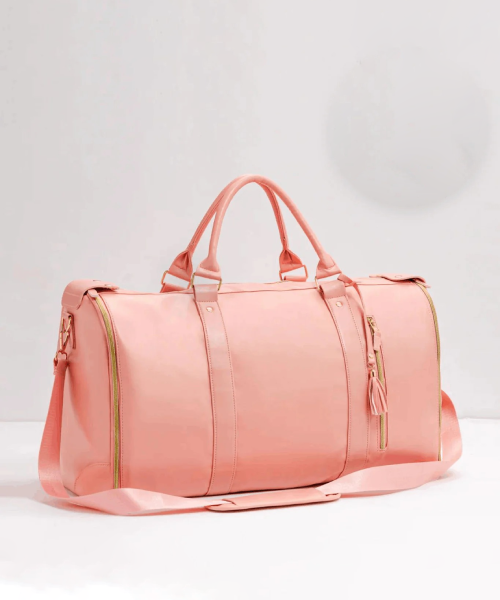
The Travel Bag 2.0 is the one that started everything. It’s designed specifically to carry ten or more days of clothes in a carry-on compliant size, with a garment section that holds dresses and shirts without the folding and squashing that causes wrinkles. The size is 20 x 9 x 12.5 inches, which meets the carry-on requirements for most major airlines. They claim it fits three dresses plus ten-plus days of clothing and I’ve tested this across a nine-day trip to two different cities — it’s accurate.
The material is a high-fibre PU leather, which is vegan leather that’s both durable and easy to wipe clean. Important for a travel bag because things happen — coffee in airports, overhead bins that aren’t as clean as you’d like, rain between the car and the terminal. The fact that it wipes rather than absorbs means it looks the same at the end of the trip as it did at the start.
What makes it work differently from a standard duffel is the internal organisation. There are dedicated sections that keep things separated — garments on one side, shoes and toiletries away from clean clothes, accessories in flat pockets so you’re not digging to find them. A well-organised bag makes packing faster and unpacking at the hotel genuinely easy rather than the usual exercise of pulling everything out to find what you’re looking for at the bottom.
At $129 current price this is genuinely good value for a bag this thought-through. I’ve seen less considered travel bags cost significantly more and deliver significantly less.
Available at luhxe.com
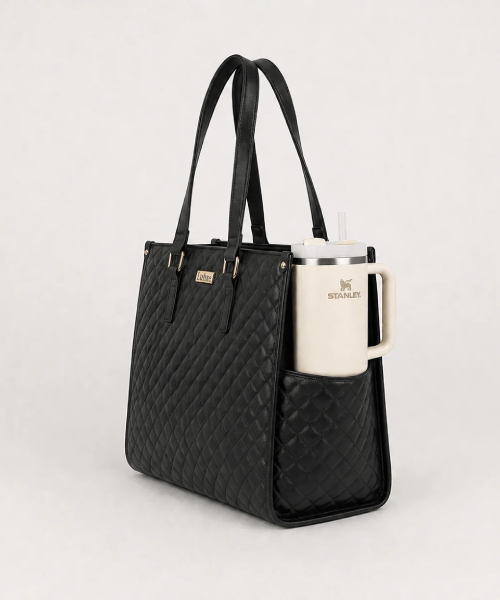
The 3 in 1 is a tote that functions as a day bag, a shoulder bag, and a crossbody depending on how you configure the straps. I use this as my personal item on flights — it goes under the seat in front of me while the Travel Bag 2.0 goes in the overhead. Between the two of them I can travel for up to ten days with everything I need and nothing checked.
The tote is also what I reach for on actual days in a city — it’s the bag that comes with me when I leave the hotel and doesn’t come back until the day’s done. It holds a lot more than it looks like it should, the strap configuration is genuinely flexible rather than just technically possible to adjust, and the material is the same easy-care PU leather as the Travel Bag.
Having one bag that functions as a travel day bag and a daily life bag means I’m not maintaining a collection of bags for different purposes. The 3 in 1 at $80 is the most-used bag I own right now, which makes it one of the better purchases I’ve made in the past two years by cost-per-use.
Available at luhxe.com
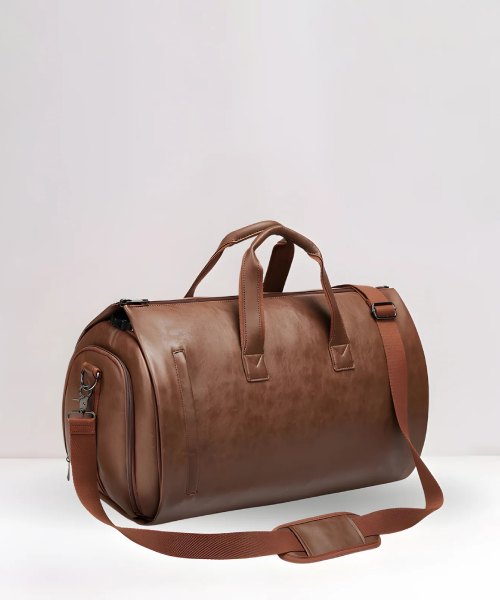
The Leather Duffel is what I use when the trip involves more physical activity — hiking, days where I know I’ll be getting sweaty or wet, weekends where I’m packing workout clothes alongside regular things. It’s a different use case from the Travel Bag 2.0 which is oriented toward keeping clothes neat. The Duffel is more throw-and-go, more flexible about what you put in it, more practical for the kind of trip where wrinkle-free dresses aren’t the priority.
The PU leather on this one feels more structured than the Travel Bag — it holds its shape when you put it down rather than flopping to the side — which I find useful because it means I can pack it and then easily put it somewhere and have it stay organised. At $130 it’s in the same accessible price range as the Travel Bag and covers a completely different set of travel situations.
This is the part that actually matters because a good bag is only half the answer. The other half is learning to pack for the bag rather than packing however you want and hoping it fits.
For three to four days I use the 3 in 1 Tote as my only bag. Three outfits, one pair of shoes besides what I’m wearing, minimal toiletries in a small pouch. The trick is clothing that works across situations — the same linen trousers for the daytime walk and the evening restaurant with different tops, a dress that works for casual and slightly dressed-up depending on what you layer over it or what bag you carry.
For five to nine days I take the Travel Bag 2.0 in the overhead and the 3 in 1 under the seat. In the Travel Bag — five to six outfits in the garment section, underwear and socks in a compression cube, toiletries in a waterproof bag in the base section, shoes in a shoe pouch. In the 3 in 1 — laptop, camera, chargers, the things I want access to during the flight. Everything fits. I’ve done nine days with this setup and come home with unworn things, which means the packing is efficient rather than just barely adequate.
For trips that involve outdoor activities or where getting dirty is part of the plan, the Duffel replaces the Travel Bag 2.0 and the standard is different — function over neatness, practical over precise.
I didn’t add this up properly until I looked at it across a year. A round trip with one checked bag on a budget airline is $50-100 extra. If you travel four or five times a year that’s $200-500 in fees on top of your ticket price. Add the time spent waiting at baggage claim — thirty to forty minutes is typical — and across five trips you’ve spent three or four hours standing by a conveyor belt.
The Luhxe Travel Bag 2.0 at $129 pays for itself after two or three trips if you were previously checking bags. That’s the actual financial argument and it’s a fairly straightforward one.
There’s also the stress argument. Checking a bag means one more thing to track, one more thing that can go wrong, one more thing you’re thinking about on the way to the airport and on the way home. Eliminating that is worth something that doesn’t show up in a fee comparison but shows up in how you feel at the end of a travel day.
I want to say something about the PU leather material specifically because it’s different from both genuine leather and from the cheap synthetic materials that most budget bags use.
High-fibre PU leather is more durable than entry-level synthetic and easier to maintain than genuine leather. It doesn’t crack in cold weather the way cheap synthetic does. It doesn’t require conditioning or careful treatment the way genuine leather does. It wipes clean with a damp cloth. It ages more consistently than either alternative at the same price point.
For a travel bag specifically — something that’s going into overhead bins, being thrown around airports, getting rained on occasionally, sitting on hotel room floors — these properties matter more than they would for something you’re just carrying around your neighbourhood. The ease-of-maintenance and durability of the Luhxe material has held up across eighteen months of regular use without any deterioration I’ve noticed.
I want to be honest that it required adjusting how I think about what I need to bring. The first couple of trips I still packed too much — not more than fit, but more than I actually wore, which means I was carrying things I didn’t need. Now I pack after I’ve thought clearly about every day of the trip rather than packing everything that might be useful.
The reward for that planning is arriving at a destination and walking straight out of the airport. No waiting. No worrying. No twenty-minute conversation with an airline representative about where your bag ended up. You’re there immediately, your things are on your back or in your hand, and the trip starts the moment you land.
That’s what the right travel bag enables. The Luhxe system — the Travel Bag 2.0 for most trips, the Duffel for active ones, the 3 in 1 as the daily companion — is the setup that made it work for me in practice rather than in theory.